


How to Design a Rectangle Living Room Layout: 7 Pro Layouts

Introduction
Struggling with a long, narrow living room? Rectangle layouts can feel tunnel-like, but smart furniture placement transforms them into functional, inviting spaces. Whether your room is compact or spacious, the key lies in strategic arrangements, clear traffic flow, and visual balance. In this guide, we share 7 professional rectangle living room layouts, complete with furniture tips, zoning ideas, and styling tricks that make any rectangular space feel wider, cozier, and perfectly balanced.
Ready to transform your rectangle living room from challenging to charming? Let's dive into the layouts that interior designers swear by.
Why Does My Rectangle Living Room Feel Narrow
Before jumping into specific layouts, it's crucial to understand what makes rectangular living rooms unique. These spaces typically have a length-to-width ratio of approximately 1.5:1 or greater, creating a linear floor plan that can feel tunnel-like if not properly designed.
Common Rectangle Living Room Challenges
- Visual imbalance and the "bowling alley" effect
- Awkward traffic patterns cutting through conversation areas
- Difficulty establishing a clear focal point
- Wasted space in corners or along long walls
- Challenges creating intimate seating zones in larger rooms
The solution? Strategic furniture arrangement that breaks up the length, creates purposeful zones, and guides the eye across the width rather than down the length of the room.
Universal Measurement Guidelines for Rectangle Living Rooms
These measurements apply across all layouts and will be referenced throughout:
Traffic flow and clearance:
- Minimum walkway width: 36 inches for general traffic, 42-48 inches for high-traffic areas
- Conversation distance: 4-8 feet between seating pieces
- Coffee table to sofa: 14-18 inches for legroom
- Furniture to wall clearance: 12-24 inches (varies by layout)
Rug sizing by room dimensions:
- Small rooms (10x14 to 12x16): 6x9 or 8x10 rug
- Medium rooms (12x18 to 14x20): 8x10 or 9x12 rug
- Large rooms (15x25+): 9x12, 10x14, or larger rug
- Key rule:All front furniture legs on rug, 12-18 inches floor border visible
TV viewing distance:
- 40-49 inch TV: 5-8 feet
- 50-59 inch TV: 6.5-10 feet
- 60-69 inch TV: 7.5-11 feet
- 70+ inch TV: 9-12 feet
Furniture angling guide:
- 0-15 degrees: Subtle adjustment, maintains formality
- 30 degrees: Versatile, creates conversation flow
- 45 degrees: Dramatic diagonal, requires larger rooms (15x20+)
Sofa sizing recommendations:
- Rooms 10-12 feet wide: 72-78 inch loveseat
- Rooms 12-14 feet wide: 78-84 inch sofa
- Rooms 15+ feet wide: 84-96 inch sofa
Whether your room is compact or spacious, the key lies in strategic arrangements, clear traffic flow, and visual balance. Check our small living room refresh ideas for tips on creating a bigger, cozier space.”
Layout 1: Floating Furniture Arrangement to Enhance Rectangle Living Spaces

Floating furniture creates a defined conversation area that shortens the visual length of a rectangle room. This approach allows for negative space around seating, improves traffic flow, and makes the room feel more open and inviting.
Best for:Medium to large rectangle living rooms (14x20 and larger, 280+ sq ft)
Core concept:Pull furniture away from walls to create an intimate conversation area that visually shortens the room's length.
Essential configuration:
- Sofa perpendicular to longest wall, floating 12-18 inches away from wall
- Two armchairs opposite sofa, creating face-to-face arrangement (6-8 feet apart)
- Large area rug (8x10 or 9x12) with all front furniture legs on it
- Coffee table centered between sofa and chairs
- Console table (48-72 inches long, 12-15 inches deep) behind sofa with lamps
Why it works:Interior designer Maria Chen explains, "Floating furniture creates negative space that actually makes the room feel larger while establishing a defined gathering zone. The perpendicular sofa position breaks up the length immediately."
Adapting for smaller spaces:For rooms 12x16 to 14x18, modify the approach: float sofa only 8-10 inches from wall, use a loveseat (72-78 inches) instead of full sofa, and choose armless slipper chairs (26-28 inches wide) to save space. This maintains the floating principle while accommodating tighter dimensions. See our guide on choosing a modular sofa for small living rooms for compact options that fit perfectly.
Key mistake to avoid:Pulling furniture away but leaving less than 36 inches for the main walkway creates frustration and defeats the purpose.
Real-life application:Homeowner Sarah K. from Portland used this in her 14x22 living room: "I was skeptical about pulling the sofa away from the wall, but it completely changed the feel. The room no longer looks like a hallway, and we actually use the space behind the sofa for plants and a bar cart."
Layout 2: Dual Zone Design to Divide Long Rectangle Living Areas

Dividing a long rectangle living room into two zones creates functional areas for different activities. Using a bookshelf, console, or rug as a subtle divider ensures both zones feel connected yet distinct.
Best for:Extra-long rectangle living rooms where length exceeds width by 10+ feet (12x24, 13x26, 14x28)
Core concept:Embrace the length by creating two distinct functional zones separated by a visual divider.
Essential configuration:
- Zone 1 (Primary seating):Sofa along long wall with perpendicular chairs creating L-shape, anchored by 8x10 rug
- Visual divider at midpoint:Open bookshelf (36-48 inches tall), console table, or decorative screen positioned perpendicular to walls
- Zone 2 (Secondary function):Home office, reading nook, or play area with separate 6x9 rug
- Traffic corridor:36-42 inches clear walkway between zones
Critical measurements:
- Divider height: 36-48 inches creates boundary without blocking light
- Zone split: 55/45 or 60/40 works better than strict 50/50
- Walkway positioning: Along one long wall as primary pathway
Multi-functional zone applications:
For work-from-home:Zone 1 = family seating, Zone 2 = professional desk setup. Designer Lisa Tran notes, "The bookshelf divider creates a psychological 'leaving work behind' boundary while maintaining visibility."
For families with children:Zone 1 = adult conversation area, Zone 2 = kid-friendly play space with washable rug and low storage. The low divider (30-36 inches) allows parental supervision.
Strategic divider selection:
- Open bookshelf: Maintains openness, light flows through
- Console table: Provides display/storage surface
- Floor-to-ceiling curtain: More privacy but can feel closed off
Pro tip:"The divider shouldn't be an afterthought—it's the hero of this layout," says designer Rachel Martinez. "Use a 42-inch tall bookshelf styled with books, plants, and decorative objects, filling only 60-70% of shelves to avoid clutter."
Real-life example:David K. transformed his 13x26 room: "We created a TV watching area in front with a sectional, used a 40-inch bookshelf as divider, and built a home office in back. My wife works from home and now has a dedicated space that feels separate, but we can still chat across the bookshelf."
Layout 3: Angled Seating to Break the Tunnel Effect in Rectangle Rooms

Angled furniture disrupts linear sight lines and adds visual interest to rectangle spaces. Positioning sofas or chairs at 30 to 45 degrees encourages diagonal movement and makes the room feel more dynamic.
Best for:Spacious square-ish rectangles (15x20 minimum, 300+ sq ft) where visual interest is priority
Core concept:Break linear sight lines by positioning sofa at 30-45 degrees in a corner.
Essential configuration:
- Sofa angled at 30-45 degrees from chosen corner (diagonal from entry)
- Chairs or loveseat complement the angle at 90 degrees to sofa
- Coffee table follows the angle (oval or round 42-48 inches works best)
- Fill sharp corners with floor lamps or tall plants (6-7 feet)
Critical angle guidelines:
- 30-degree angle: Subtle, works for rooms 15x18-16x20
- 45-degree angle: Dramatic, requires 18x22+ rooms
- Angle test:For 45 degrees, measure from corner—sofa back should be equal distance from both walls
Why it works:"Angling furniture disrupts linear sight lines that make rectangle rooms feel like corridors," notes designer James Rodriguez. "It forces the eye to move diagonally, creating spaciousness."
Working with architectural irregularities:
For rooms with columns:Use the column as your "corner" anchor point—angle furniture from the column instead of wall corner, turning an awkward feature into a design asset.
For bay windows:Angle sofa toward bay window at 30 degrees, creating natural orientation toward view while maintaining diagonal advantage.
Requires strong focal point:Large window (6+ feet wide), fireplace, statement TV wall (55+ inches), or created focal point like large-scale artwork (40x60 inches+).
Key mistake to avoid:Angling furniture in rooms under 15x18 creates cramped feeling and unusable triangle-shaped dead zones. Also, timid 10-15 degree angles look accidental—commit to 30 or 45 degrees.
Layout 4: Wall Hugging Furniture Plan for Compact Rectangle Living Rooms
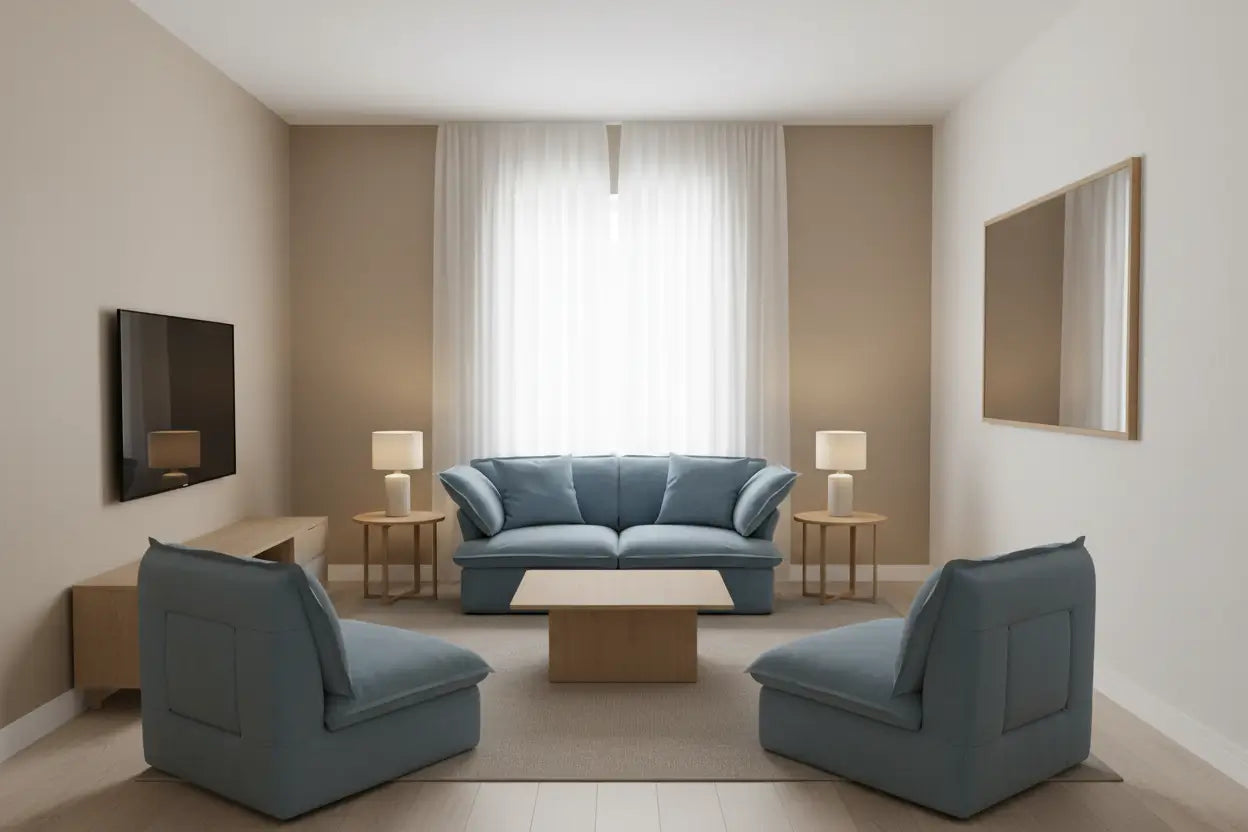
Placing furniture against walls maximizes floor space and maintains symmetry in small rectangle rooms. Pairing matching chairs or loveseats with a central rug helps maintain balance and open pathways.
Best for:Small rectangle living rooms (10x14 to 12x18, 140-220 sq ft)
Core concept:In tight spaces, strategic wall placement maximizes floor space while symmetry creates visual balance.
Essential configuration:
- Sofa centered on one short wall (equal space both sides)
- Matching chairs or loveseat on opposite short wall
- Media console (50-60 inches) centered on one long wall with TV above
- Opposite long wall kept mostly clear for traffic
- Rug (6x9 or 8x10) oriented widthwise
Room-specific sizing:
- 10x14 rooms:72-76 inch loveseat, 28-32 inch armless chairs, 36-42 inch coffee table
- 12x16 rooms:78-84 inch sofa, 30-34 inch armchairs, 42-48 inch coffee table
Content gap - Visual expansion techniques:
Mirror placement strategy:Place large mirror (40x60 inches minimum) on long wall opposite window to reflect light and create width illusion. Designer Rachel Martinez: "Never place mirrors on short walls in narrow rectangles—it emphasizes length and worsens the bowling alley effect."
Furniture leg exposure:Choose pieces with exposed legs (6-8 inches high) rather than skirted bases—seeing floor underneath creates visual lightness.
Color approach:
- Short walls: Can handle darker/bolder colors (pulls them forward, shortens length)
- Long walls: Keep light (white, cream, pale gray)
- Ceiling: Paint one shade lighter than walls
Pro tip - Symmetry rule:"Symmetry is your best friend in small rectangles," explains designer Lisa Tran. "Center everything on short walls with equal space both sides. Match lamps, artwork placement, even shelf heights. This creates calm that makes small spaces feel larger."
Real-life application:Designer Maria Chen worked with an 11x15 room: "We centered a 76-inch loveseat on one short wall, two armless chairs opposite, and hung a 40x60 inch mirror on the long wall reflecting the window. The 6x9 rug oriented widthwise made the room feel spacious and pulled together."
Layout 5: L Shaped Sectional Setup for Family Friendly Rectangle Spaces

An L-shaped sectional optimizes seating while complementing rectangle room geometry. This layout provides a cozy gathering spot, keeps traffic clear, and works well for families or pet owners.
Best for:Family-focused rectangle living rooms of any size (12x16 to 20x28), TV-watching and social gatherings
Core concept:Sectionals create automatic L-shape that works with rectangle geometry while maximizing seating.
Essential configuration:
- Long section (96-120 inches) along one long wall
- Return section (60-84 inches) extends perpendicular into room
- Large rug (9x12 or 10x14) with all sectional legs on it
- Focal point opposite: TV wall or fireplace on other long wall
- Optional accent chair perpendicular to return section
Sectional sizing by room:
- 12x16 rooms:96" long + 60" return, 8x10 rug
- 14x18 rooms:108" long + 72" return, 9x12 rug
- 16x22+ rooms:120" long + 78" return, 10x14 rug
Ideal proportion:Long side to short side ratio of 1.5:1 to 1.7:1 (example: 108" + 72" = 1.5:1)
Family and pet optimization:
For families with children:Designer Sarah Lopez: "Sectionals are family gold—tons of seating, no gaps where kids fall through. Choose performance fabrics (Crypton, Sunbrella) in medium grays or navy that hide wear. Read our best pet-friendly sofa types for more durable options.
For pet owners:
- Fabric: Microfiber or performance fabrics (easier to clean)
- Color: Medium tones with patterns hide pet hair
- Removable covers: Essential for accidents
- Leave 18-24 inches between sectional and walls for pet walking paths
Coffee table sizing formula:Coffee table length should be 1/2 to 2/3 the long sectional section length. For 108-inch section = 54-72 inch table. Round tables (42-48 inches) work beautifully in the L-shape.
Traffic flow critical:Return section projects into room—ensure 42 inches minimum between return and opposite wall/furniture for comfortable passage.
Key mistake to avoid:Sectional too large for room blocks walkways. In 12x16 room, max 96" sectional; anything larger overwhelms the space.
Real-life example:Jennifer M. with 14x19 room and two dogs: "We replaced sofa and loveseat with a 106" + 70" sectional in charcoal performance fabric. The L-shape created a perfect doggy nest in the corner, we gained two extra seats, and the 9x12 rug grounds it all. It finally feels like an actual room."
Layout 6: Fireplace and TV Centered Arrangement for Rectangle Living Areas

Focusing the layout around a fireplace or TV creates a natural gathering point. Arranging sofas and chairs around the focal point ensures comfortable viewing and balanced proportions throughout the room.
Best for:Rectangle living rooms with prominent architectural features (any size, particularly effective 14x18 to 18x24)
Core concept:Build layout around existing focal point while maintaining proportional balance.
Two primary configurations:
Configuration A - Focal point on short wall:
- Fireplace/TV centered on short wall
- Sofa parallel on opposite short wall, 8-12 feet away
- Two chairs flanking focal point, angled 15-30 degrees inward
- Rug with all front legs on it
Configuration B - Focal point on long wall:
- Fireplace/TV centered on long wall
- Sofa perpendicular to focal point, creating L-shape
- Chairs on opposite long wall angled toward focal point
- Balance opposite wall with large artwork or mirror
Seating distance from focal point:
- Fireplace: 6-8 feet minimum (heat consideration)
- TV: Follow viewing distance guidelines (see Understanding section)
- Conversation: 8-12 feet for comfortable interaction
Dual focal point dilemma (fireplace + TV):
This is a common design challenge. Three solutions:
Solution 1: TV above fireplace
- Pros: One unified focal point, saves wall space
- Cons: TV often too high (neck strain), heat concerns
- How to make it work:Use tilting mount angled 10 degrees down, ensure mantel is 48 inches high (not 54-60), install heat shield, TV width = 2/3 fireplace width max
Solution 2: TV on adjacent wall
- Pros: TV at proper eye level, fireplace remains decorative
- Cons: Competing focal points
- How to make it work:Position sofa at 45-degree angle between both, or use swivel chairs
Solution 3: TV in closable cabinet
- Pros: TV hidden when not in use, fireplace primary
- Cons: Requires custom cabinetry (expensive)
Designer Lisa Tran: "Ask clients what percentage of time they use TV vs. enjoy fireplace decoratively. If 80% TV watching, mount above fireplace and optimize for that reality. If 50/50, create two zones."
Balancing proportions when focal point on long wall:Paint focal point wall bold/dark color to "pull it forward," keep opposite long wall lighter. Use substantial artwork (48x72 inches+) or gallery wall (6-9 feet wide) on opposite wall for visual weight balance.
Layout 7: Open Concept Design to Define Zones in Rectangle Living Rooms

Using furniture and rugs to define zones maintains openness in rectangle open-concept spaces. Layering seating, lighting, and consoles creates distinct living, dining, or work areas without walls.
Best for:Rectangle living rooms flowing into dining/kitchen in open floor plans (14x20+ within larger 25x30+ combined space)
Core concept:Create definition without walls using sofa as room divider and layered zoning elements.
Essential configuration:
- Sofa with back facing dining/kitchen area, 4-6 feet from living zone edge
- Tight furniture grouping: sofa + chairs + coffee table within 10x12 footprint
- Large rug (8x10 minimum, 9x12 ideal) defining living space—all furniture on it
- Console table behind sofa (48-72 inches long, 12-16 inches deep, 30-36 inches high)
- Clear sight lines maintained to other areas
Critical clearances:
- Sofa back to dining table: 48-54 inches ideal (allows chair pull-out + walking)
- Sofa back to kitchen island: 54-60 inches ideal
- Floor gap between rug edge and sofa back: 12-18 inches (strengthens separation)
=Zone definition without walls (layer approach):
Designer Sarah Lopez: "Open-concept doesn't mean everything floating. It means layering elements—rugs, furniture orientation, lighting, subtle barriers—to create perceived separation while maintaining flow."
Layer 1: Flooring and rugs
- Kitchen: Hard flooring (no rug)
- Dining: Separate rug under table OR continue hard floor
- Living: Large rug defining conversation zone
- Use different rug styles/colors in each zone for distinction
For additional seating ideas during entertaining, explore living room seating ideas for game day.”
Layer 2: Lighting zones
- Kitchen: Bright task lighting (pendants over island)
- Dining: Medium decorative lighting (chandelier)
- Living: Warm ambient (table lamps, floor lamps)
- Each zone independently controllable with dimmers
Layer 3: Console table as functional dividerServes multiple purposes:
- Lighting:Two table lamps for living room
- Storage:Baskets underneath for blankets/remotes
- Visual barrier:Tall items (24-30 inch lamps, vases) create screening effect
- Styling:Symmetrical arrangement (lamp-books-centerpiece-books-lamp)
Sofa back aesthetics matter:Since visible from dining/kitchen, choose:
- Tight back with visible trim (clean lines)
- Tufted back (adds texture)
- Nailhead trim (decorative detail) Avoid exposed frames, mismatched pillows from behind
Color cohesion across zones:
- Base neutral in all zones (walls, large furniture)
- 2-3 accent colors repeated across zones (blue pillows in living, blue artwork in dining)
- Material repetition: wood tones should match
Pro tip - Rug boundary technique:"If it's in the living room functionally, it sits on the living room rug," says designer Rachel Martinez. "The moment you step from hard floor to living rug, your brain registers 'I'm in a different space,' even without walls."
Real-life example:Michael T. with 16x24 living area in open-concept: "We floated our 90-inch sofa with back facing kitchen, positioned on 9x12 charcoal rug, added 66-inch console behind with two lamps. Now it feels like an actual living room. The console was the game-changer—creates just enough separation that dining and living feel distinct, but we can still chat with people in the kitchen."
Common Mistakes to Avoid Across All Rectangle Living Room Layouts
Avoiding common layout mistakes helps your rectangle living room feel spacious and functional. Paying attention to furniture placement, rug size, and traffic flow prevents cramped or awkward spaces while enhancing comfort and style.
Furniture placement errors:
- Lining furniture in a row along long walls (creates bowling alley effect)
- Oversized furniture in small rooms (96-inch sofa in 10x14 room overwhelms). Check our small living room refresh ideas for styling tips in compact spaces.
- Blocking main walkways with less than 36 inches clearance
- Pushing all furniture against walls in large rooms (wastes intimate potential)
Rug and flooring mistakes:
- Rug too small (5x7 in medium room looks like postage stamp)
- Wrong rug orientation (running lengthwise emphasizes tunnel effect)
- No rug at all (furniture looks disconnected and floating aimlessly)
Visual balance errors:
- Ignoring the wall opposite your focal point (creates lopsided feel)
- Using only one central overhead light (emphasizes length, creates shadows)
- Placing focal points on long walls in narrow rectangles without balance elements
Traffic flow failures:
- Creating pathways through conversation areas instead of around them
- Insufficient clearance for daily movement (bumping into corners)
- Blocking room entry with furniture backs
Scale and proportion issues:
- Dark colors on all walls in small rectangles (cave-like feeling)
- All furniture same height (creates visual monotony)
- Timid furniture angles (10-15 degrees looks accidental, not designed)
Conclusion
A well-planned rectangle living room balances style and function without renovations. From floating furniture zones to dual-purpose layouts, each strategy adapts to any space and lifestyle. With WJS Home's expert tips and design guidance, you can create intimate conversation areas, clear traffic flow, and strong focal points, turning challenging rectangular rooms into comfortable, stylish, and perfectly proportioned spaces. Trust WJS Home to help your rectangle living room feel spacious, inviting, and ready for relaxing, entertaining, or family moments.