


Most sofa trend guides tell you what's popular. This one tells you what sofas are actually worth buying — and what you'll regret.
We'll cover the sofa trends that have real staying power in 2026, the ones that are already fading, and how to make a decision you won't second-guess in five years.
Why Sofa Design Is Shifting in 2026
Trends don't come from nowhere. They're always a reaction to something.
The trends worth following solve a real problem. The ones worth ignoring are just reactions to other trends — they look fresh for a moment, then fade.
Two things changed how we think about sofas, and they're behind almost everything you're seeing in 2026.
Reason 1: Minimalism Made Living Rooms Feel Cold
For about a decade, the dominant style was Scandinavian minimalism. Clean lines. Cool grays. Nothing extra.
It made sense at the time — a pushback against the heavy, ornate interiors that came before. But after ten years, it started creating its own problem: living rooms that felt cold, bare, and a little joyless. Rooms that looked great in photos but weren't actually comfortable to be in.
The shift toward warmth, curves, and texture isn't a passing fad. It's people course-correcting after a decade of restraint.
Reason 2: Sofas Became Everyday Furniture
Not long ago, the sofa was basically a guest piece. Something you bought to look good when people came over.
That's not how most people use their sofa anymore. Post-2020, the sofa became the place where people work, watch TV, take calls, nap, and spend most of their time at home. It's the most-used piece of furniture in the house.
That shift explains a lot about what's trending right now: deep seats, soft fabrics, flexible configurations — designs that work for real life, not just for company.
2026 Sofa Trends That Actually Hold Up
For each of these, ask the same question: does this solve a real problem? And will that problem still matter in five years? These four pass that test.
Curved Sofas Make Small Rooms Feel Bigger
Curved sofas aren't just a look. They do something a straight sofa can't.
A rectangular sofa with square arms breaks a room into hard chunks. Your eye hits each corner and stops. A curved sofa lets your eye move smoothly around the piece — the room feels more open, not chopped up.
That's why designers put curved sofas in small apartments. Counterintuitively, a well-sized curved sofa often makes a small room feel bigger. In open-plan spaces, it can even act as a natural room divider — defining areas without walls.
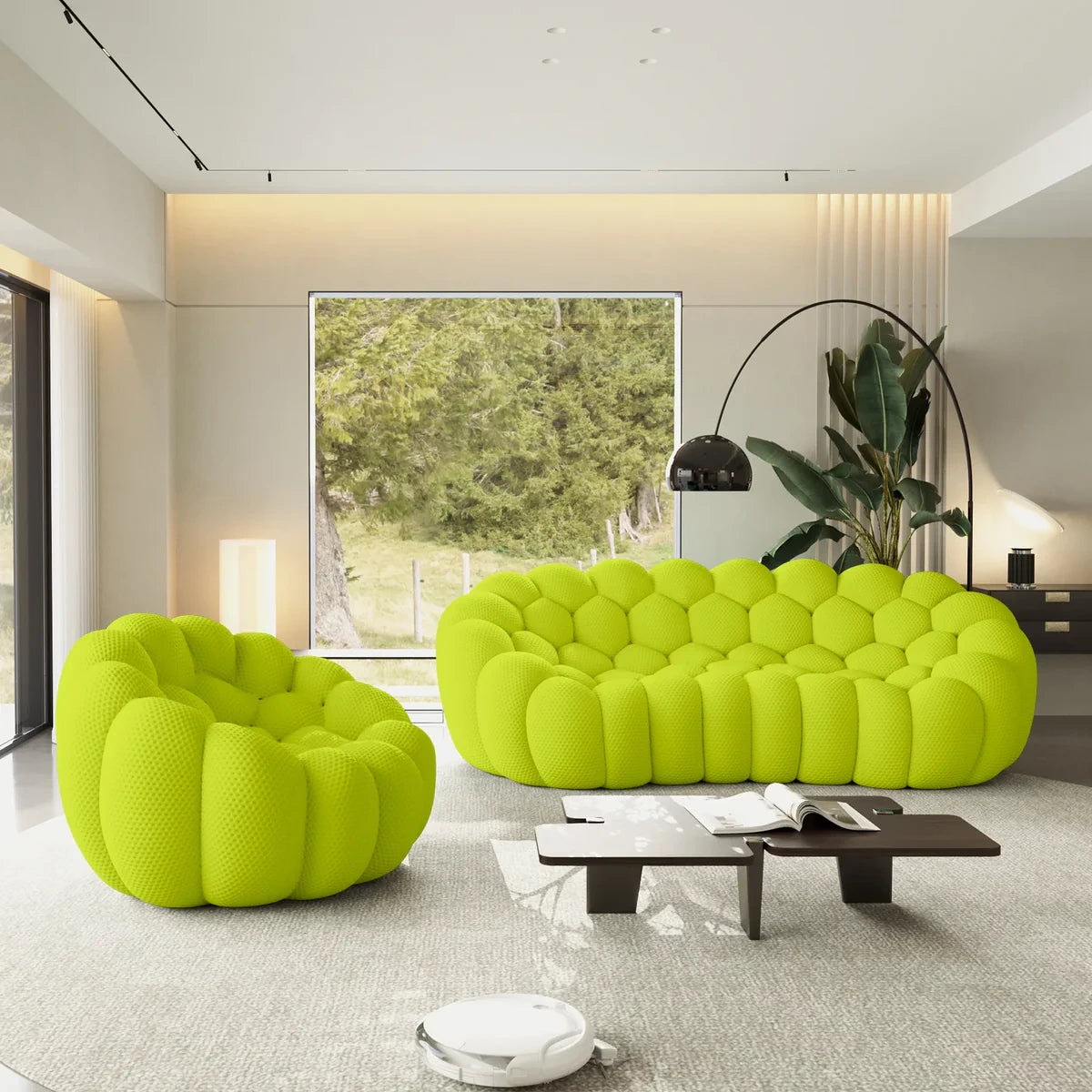
⚠️ The designer debate (worth knowing before you buy)
Not everyone loves the curve.
New York designer Rana Abernethy warns: “In a small apartment, the backside curve wastes space — you can't push it flush against a wall.” Her fix: a transitional shape (curved on one end, straight on the other).
Designer Meredith Vanderford adds that armless sofas sacrifice a place to lean or rest a book. Her fix: a low arm (4-6 inches) or a pillow arm — most of the visual lightness, none of the lost function.
Warm Neutrals Replace Cool Gray
The colors moving in 2026 share one thing: they feel warm without being loud. Here's how the four leading sofa colors 2026 compare.
- Terracotta - Earthy and grounded. Pairs best with wood tones, cream textiles, and natural fiber rugs.
- Sage green - Calm and organic. Works with linen, warm whites, and matte finishes.
- Warm oat - Soft and versatile. The new true neutral — fits almost everything.
- Earthy brown - Rich and warm. Complements leather, brass, and deep wood tones.
These warm tones are systematically replacing cool gray as the default sofa color. Pantone's 2026 palette leans warm. A 1stDibs survey of 468 professional designers found chocolate brown and mocha tones replacing gray-and-beige combinations. King Living's analysis of hundreds of thousands of sofa purchases confirms the same: warm tones are gaining share while cool grays decline.

What about deeper colors?
Burgundy and petrol blue are also showing up — but as accent pieces, not as the main sofa. A reading chair or loveseat in a bold color adds personality. Use the same color on your primary sofa in a light room, and it quickly feels overwhelming.
Performance Velvet Lasts Longer Than Bouclé
The sofa fabric you choose matters more than most people realize. Here's how the main 2026 options compare:
| Fabric | Look | Durability | Best for |
| Bouclé | Luxurious, textural | Low — pills and catches | Low-traffic rooms, secondary seating |
| Performance velvet | Rich, soft, slightly shiny | High — resists staining and crushing | Primary family sofa, daily use |
| Corduroy | Warm, textural | Medium — ribs flatten over time | Occasional-use rooms only |
| Linen | Natural, relaxed | Low — wrinkles and stains easily | Guest rooms, formal spaces |
For most households, performance velvet is the right call. It looks just as good as bouclé, holds up significantly better, and comes in all the 2026 colors — terracotta, sage, deep teal. A sofa that still looks good in five years is always a better sofa than one that looked great on the day it arrived.
Modular sofas Adapt When Your Life Changes
Modular sofas are growing in popularity because they solve a problem a regular sectional can't: what happens when your life changes?
A fixed sectional is locked into one layout in one room. Move to a different apartment, rearrange the space, or go from living alone to living with a family — and it either works or it doesn't. A modular sofa lets you reconfigure. The same pieces that form an L-shape in a big open-plan space can split into a sofa and a separate armchair in a smaller room.

The biggest mistake: buying too much.
Showroom setups are designed to look impressive in large spaces. For a typical living room (around 12 by 15 feet), a three or four-seat setup plus one corner piece is usually plenty. More than that and the sofa starts eating the room.
One thing that catches buyers off guard: modular sofas tend to sit slightly higher and feel a bit firmer than regular sofas because of the connecting hardware. Always sit in the actual pieces you're buying before you commit.
A fixed-frame sofa is still the better choice if your space isn't changing. Better joinery, more solid construction, and tends to age more gracefully. If you know where you're living and what you want, a good fixed sofa will serve you better long-term.
Sofa Trends Already Fading in 2026
These three are on the way out — and understanding why helps you avoid buying something that's already behind.
All-Gray Rooms: They Feel Flat and Cold Now
All-gray interiors made sense as a reaction to cluttered aesthetics. But once it became the default, it started creating a new problem: rooms that feel flat, cold, and soulless.
The shift away from cool gray is now across the board. Pantone, Dulux, and Farrow & Ball have all moved toward warmer palettes. Interior designer Chloe Dacosta notes that show home developers have "almost universally" abandoned cool gray staging.
Gray isn't dead - a warm gray or greige can still work. The problem is the all-gray room: walls, sofa, rug, and accessories all in the same cool tone. That specific look now feels dated and is hard to fix without changing everything. If you're buying new, avoid that palette.
Track Arm Sofas: They're Everywhere and Blend in
The track arm sofa — flat arms, oversized cushions, boxy proportions — was "modern" for about twenty years. It's everywhere. And that's exactly the problem.
When something is everywhere for long enough, it stops reading as a choice. It just reads as the default. Nobody looks at a track arm sofa and thinks it was carefully selected — it's the furniture equivalent of a generic apartment kitchen.
The shift isn't toward anything complicated. Just toward something that looks like a decision was made: a curve, a tapered leg, a lower profile, a more considered arm shape.
Fast furniture: Cheap Upfront, But Costs More Over Time
Fast furniture used to be a reasonable trade-off — lower quality, but low enough price to make it worthwhile. That trade-off has fallen apart.
Prices have gone up significantly without quality improving.
A sofa that cost $400 a few years ago now costs $600-$700 — same cheap foam, same frame held together with staples and glue.
Do the math: a $650 sofa that lasts three years costs more per year than a $1,500 sofa that lasts ten. The value case doesn't hold up anymore, and buyers are noticing.
How to Buy a Sofa in 2026 Without Regretting It
Knowing the trends is only half the job. Here's how to use them to make a good decision.
1. Match the trend to your actual timeline
Shape trends last seven to twelve years. Color trends cycle in three to seven. If you're keeping a sofa for a decade, put your money into the shape — a curved or low-profile silhouette will still feel right long after a specific color has gone in and out of style. Use trend colors in pieces that are easy to swap: throw pillows, rugs, accent chairs.
2. Prioritize shape over color
When you have to choose, go with the great shape in a safe color over the safe shape in a trending color. A curved sofa in warm oat will still look good in ten years. A track arm sofa in terracotta will date faster — when the color cycles on, there's nothing left to carry it. The shape is what gives a sofa longevity.
3. Let your actual lifestyle choose the fabric
Before committing to any fabric, ask honestly: how is this sofa actually going to be used? Heavy daily traffic, pets, kids — let that answer drive the decision, not how it looks under showroom lighting. For most households, performance velvet is the right call: same rich look as bouclé, significantly better durability, available in all the right 2026 colors.
4. Match the trend to your actual budget
| Budget Range | ✅ What to invest in | ❌ What to skip |
|
Under $1,000
(Entry-level / fast-furniture alternative) |
Warm neutral color (oatmeal / sand / sage)
Straight or low-arm shape Performance velvet |
Bouclé (pills too fast)
Modular with metal connectors (loosen within 2 years) |
|
1,000-2,500
(Mid-range sweet spot) |
Hybrid curved-straight shape (one end curved) 2-3 piece modular starter set Kiln-dried hardwood + high-density foam |
Full curved sofa (needs better construction) Low-grade corrected leather (cracks over time) |
|
Over $2,500
(Premium / long-hold) |
Full curved steam-bent frame
Performance velvet or wool-blend fabric Full modular configurability (if wanted) |
Brand markup over build quality
Leather unless it's full-grain aniline (budget $4k+) |
One rule across all budgets: Avoid the fading trends entirely — all-gray rooms, overstuffed track arms, fast-furniture pricing — because they date the fastest and are hardest to resell, no matter how much you spend.
Conclusion
Every trend worth following in 2026 comes back to the same shift: away from furniture that looks good for an audience, toward furniture that actually works for the people living with it.
Warmer colors, softer shapes, more practical fabrics, smarter configurations — these directions hold up because they're solving real problems, not just reacting to what came before.
The question to ask about any sofa isn't whether it's trending. It's whether it still makes sense in five years. Everything in this guide that passes that test is worth betting on.
[Explore our 2026 collection to see how these colors and textures work in your own home.]
FAQ
Are curved sofas going out of style or just getting started?
Just getting started — we're in the early-to-middle phase, not nearing the end.
Shape trends move more slowly than color trends. The practical arguments for curved forms — better spatial flow, visual lightness, and social optimization — give them durability beyond fashion. Curved sofas have appeared repeatedly throughout design history for the same reasons they're prominent now. This isn't a fleeting fad; it's a return to a form that solves real spatial problems.


