


7 Minimalist Living Room Ideas for a Clean Aesthetic

Introduction
A minimalist living room is not an empty room. It is a space where every piece of furniture, color, and object has a clear reason to be there — and because nothing competes for your attention, your brain stops scanning for threats and settles into the room instead of fighting it.
The result is a clean aesthetic that feels calm, functional, and genuinely livable. Whether you are starting from scratch or editing what you already own, these 7 minimalist living room ideas give you a practical, room-by-room path to get there.
Minimalist Living Room Rules Before You Start
Before choosing furniture or paint colors, a few simple rules help you make faster, more confident decisions. Think of these as guardrails — not restrictions — that keep your minimalist living room decor from drifting back toward clutter.
| Rule | What It Means | How to Use It |
| 2-3 Color Rule | Limit the palette to 2-3 main colors to reduce visual noise | Base neutral + warm wood tone + one accent color |
| 3-4-5 Styling Rule | No more than 3-5 objects on any single surface | Apply to coffee table, shelf, and console |
| 12-12-12 Decluttering Rule | Find 12 items to discard, 12 to relocate, 12 to donate | A reliable starting point for a first-time room edit |
| One Focal Point Rule | Each room has one dominant visual anchor — and one only | Sofa wall, fireplace, coffee table area, or a single art piece |
7 Minimalist Living Room Ideas for a Clean Aesthetic
These 7 ideas are the core of a clean, ordered living room. Each one addresses a specific design decision so you can apply them in sequence rather than picking from a list of 30 overlapping tips.
Idea 1. Start With a Warm Neutral Base
The fastest way to build a minimalist living room is to anchor the entire space in a warm neutral — not a stark, cold white. Warm neutrals like beige, greige, soft taupe, and warm white reflect light without creating the high contrast your eye has to resolve — which is why a room painted in warm white reads as calm where a bright cool white reads as clinical.

For anyone who worries minimalism will feel cold or sterile:
- Choose: warm white, beige, greige, soft taupe, matte wall finishes
- Avoid: harsh bright white, high-contrast color combinations, overly glossy wall paint
For rooms where the sofa is the largest visual element, pairing a warm neutral wall with a fabric sofa in a tone-on-tone shade — linen, oatmeal, or dusty blush — keeps the palette consistent without feeling monotonous. If you want a reference point for how color and sofa style interact, the WJS Home sofa collection covers a range of neutral and accent tones worth comparing.
Idea 2. Choose Low-Profile Furniture With Clean Lines
Low-profile furniture with straight, simple lines reduces the visual weight of a room without removing any actual seating or storage capacity. A sofa with slim legs and a low back allows more wall and floor space to remain visible — and the more uninterrupted floor a room shows, the larger the brain perceives that space to be, because exposed floor reads as available distance rather than occupied territory.

For small living rooms that feel cramped regardless of what is in them:
- Choose: slim tapered legs, low-profile sofas, simple flat or track arms, narrow coffee tables
- Avoid: bulky sectionals with thick rolled arms, oversized coffee tables, heavily skirted or upholstered furniture bases
If you are working on the layout and not sure how to position lower-profile pieces, the guide on small living room layout covers furniture placement principles that pair directly with this approach.
Idea 3. Keep One Clear Focal Point
A minimalist living room works best when there is one clear visual anchor — a sofa wall, a fireplace, a piece of art, or a well-styled coffee table — and everything else in the room points toward it rather than competing with it. When the eye enters a room and finds one clear anchor, it knows where to land — without that anchor, the same sparse room reads as unfinished rather than calm, because the brain interprets absence of focal point as absence of intent.

To establish a focal point, decide which element naturally draws the eye when you stand at the room's entrance. Arrange all seating to face or orient toward that element, and keep everything else — side tables, decor, storage — secondary in scale and visual weight. For a broader look at how different living room styles handle focal points and furniture groupings, the transitional living room ideas guide offers useful comparison.
Idea 4. Use Hidden Storage to Reduce Visual Clutter
Closed, concealed storage is the most practical tool in a minimalist living room because it keeps everyday clutter — remotes, chargers, books, throws — out of sight without requiring you to own less. The cleaner the surfaces, the more intentional the room feels, even on days when life is not particularly tidy.

For anyone whose living room resets to cluttered within days of organizing:
- Choose: closed-door media consoles, storage ottomans, coffee tables with drawers, lidded baskets, built-in shelving with cabinet sections
- Avoid: open pile-up on shelves, exposed cable clusters, small visible items scattered across multiple surfaces
Idea 5. Layer Natural Textures Instead of Extra Decor
In a minimalist living room, texture does the decorative work that color and pattern do in busier spaces. A linen cushion, a wool throw, a rattan tray, or a solid wood side table all add visual depth without adding visual noise — which is exactly what minimalist room decor requires.
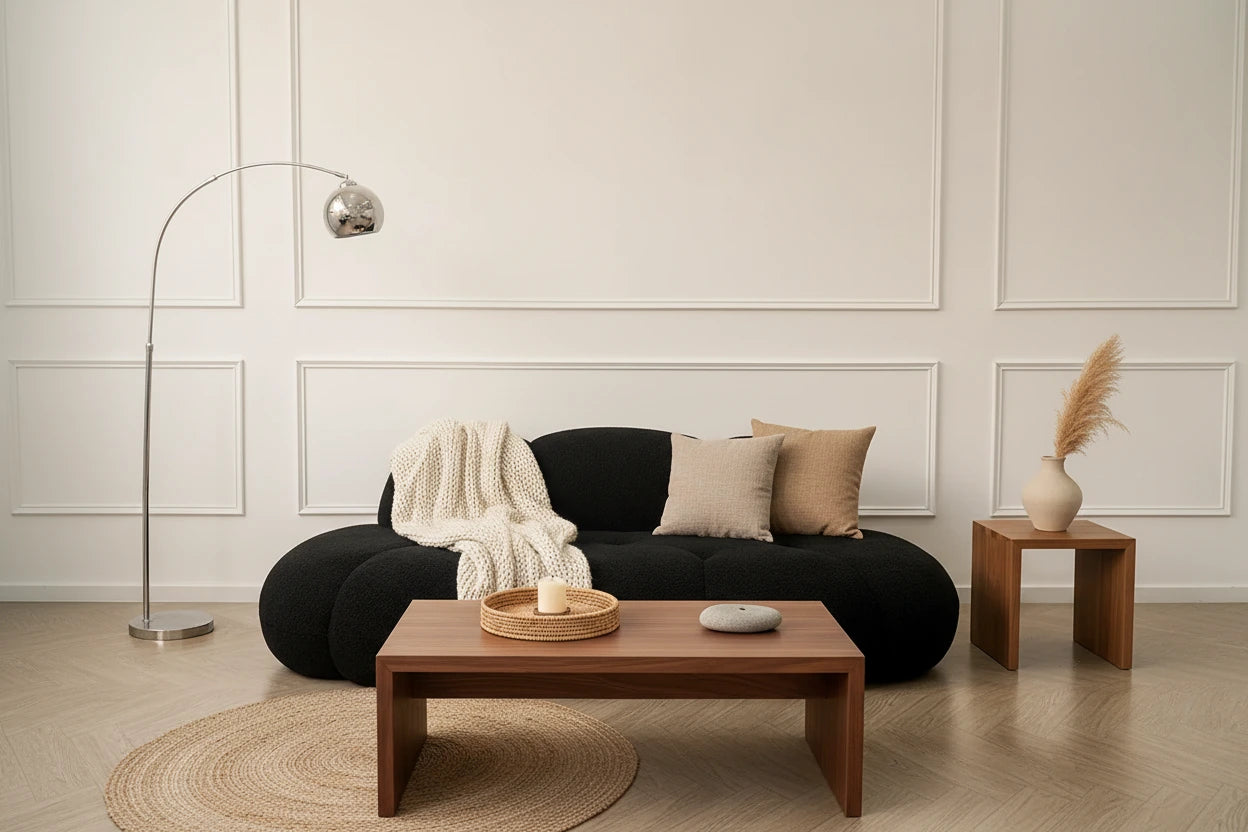
【Layer Natural Textures Instead of Extra Decor】
The most effective texture combinations stay within the same tonal family: warm wood + matte linen + stone or ceramic. This approach draws from Japandi design principles, which prioritize natural, honest materials over decorative accessories. Japandi — a fusion of Japanese wabi-sabi and Scandinavian simplicity — is one of the closest design philosophies to minimalism in practice: both reject excess, favor function, and treat material quality as the primary form of decoration. Rather than adding another object, swapping a synthetic fabric for a natural one shifts the feel of the room without changing its footprint. Explore more ideas in this area at WJS Home.
Idea 6. Leave Negative Space Around Key Pieces
Negative space — the deliberate empty area around a sofa, along a wall, or in a corner — creates visual breathing room in a minimalist living room. That open area gives the eye a place to rest between objects, which is what produces the calm, intentional feeling that separates minimalism from a room that simply feels underfurnished.

For anyone who instinctively fills blank walls and empty corners:
- Choose: breathing room around the sofa back and sides, open floor space between seating and coffee table, one or two empty wall sections left intentionally bare
- Avoid: filling every corner with a plant or floor lamp, lining all walls with furniture, adding decor pieces without first asking whether the space actually needs them
Idea 7. Add One Sculptural Accent
One well-chosen accent — a floor lamp with a considered shape, a single armchair in a quiet contrast, a ceramic vase, or a low sculptural side table — prevents a minimalist living room from feeling flat without reintroducing clutter. The key is that it is one, and it earns its place by adding something no other piece in the room provides. A simple test: if removing the piece would make the room feel noticeably flatter or less complete, it belongs. If removing it would barely register, it does not.

For minimalist room decor, the accent should have a clear shape and a matte or natural finish. A linen accent chair in a complementary neutral, a hand-thrown ceramic piece on the coffee table, or a single arc floor lamp positioned beside the sofa are all choices that add dimension without fragmentation. If you are unsure how this piece scales to your existing furniture, reviewing a sofa dimensions guide first helps confirm proportions before committing to any accent.
How to Apply Minimalist Living Room Ideas by Room Size
The 7 ideas above work in any room, but the priority order shifts depending on square footage. This section maps the same ideas to small, medium, and large living rooms — not as a new minimalist living room layout guide, but as a quick reference for which ideas matter most in each context.
Small Minimalist Living Room
In a small minimalist living room, visual weight is the first problem to solve — not because small rooms can't hold furniture, but because the eye has less empty space to rest in, so every bulky or tall piece reads as more dominant than it would in a larger room. A room that feels crowded is almost always carrying too much furniture scale, too many surface items, or both.
Start with Warm Neutral Base, Low-Profile Furniture, Hidden Storage, and Negative Space — these four have the biggest impact on how open a small room reads.
For a small minimalist living room, a two-seat modular sofa with a low profile keeps the footprint compact while still providing comfortable seating. The Cloud Orange 2-Seater is worth considering — its modular build and low silhouette suit a room where every inch of visible floor space counts.

Medium Minimalist Living Room
A medium living room is the hardest size to get right in a minimalist scheme: large enough that sparse furniture looks deliberately placed, but small enough that over-furnishing collapses the negative space that makes the style work. The main challenge is keeping the arrangement coherent — furniture, rug, and focal point all need to relate clearly to each other.
Prioritize One Clear Focal Point, Natural Textures, Negative Space, and Sculptural Accent — these keep a mid-sized layout from looking either overcrowded or underworked.
A four-seat L-shaped sectional works well in a medium room when sized correctly to leave walking clearance on all sides. The Deluxe Cloud L-Shaped Sofa offers a modular format that can be adjusted as the layout evolves.

Large Minimalist Living Room
A large minimalist living room fails differently than a small one — not through crowding, but through the eye losing its anchor point when furniture sits isolated in open floor space with nothing to connect it visually. A room that is too sparse at scale feels cold and unfinished, so the solution is not to add more objects — it is to use larger, more grounded elements and anchor them with intention.
Lean on Natural Textures, One Clear Focal Point, Sculptural Accent, and Warm Neutral Base — these four prevent a large room from reading as sparse or cold.
For a large living room where seating needs to anchor a wider floor plan, a U-shaped sectional provides scale and structure without overcrowding the space. The Deluxe U-Shaped 4-Seater Sofa works as a grounded, neutral-toned centerpiece that leaves room for texture and accent pieces around it.

Conclusion
A minimalist living room works because every choice — color, furniture, texture, storage — earns its place. Start with the four rules, work through the 7 ideas, and apply them to your room size. The result is a space that stays calm and ordered without feeling cold or empty. At WJS Home, our sofa collections are designed with clean lines and neutral palettes that fit naturally into a minimalist layout — built for real life, not just for photographs.