


Compact vs Modular Sofas: Which One Should You Choose?

Introduction
Shopping for a new sofa comes down to one key question: do you need to save space, or do you need flexibility? Compact sofas prioritize space efficiency, making them ideal for smaller rooms, while modular sofas prioritize layout freedom, letting you reconfigure, expand, or split your seating over time. Knowing which matters more to you will make this decision straightforward.
What Is a Modular Sofa?
A modular sofa is made up of individual, standalone sections — such as corner pieces, armless chairs, ottomans, and chaise units — that can be arranged, expanded, or separated to suit your space and needs. Because of this built-in flexibility, modular sofas work especially well in open-plan living rooms, family households, and any home where the layout might change down the road.
What Is a Compact Sofa?
A compact sofa is a fixed-structure sofa designed with a smaller footprint, built specifically to maximize usable floor space without sacrificing comfortable seating. It's the go-to choice for studio apartments, small living rooms, rental units, and any space where every square foot counts.
Unlike modular designs, compact sofas come as a single, unified piece — which also makes them simpler to shop for and easier to place.
Key Differences Between a Compact Sofa and a Modular Sofa
The two sofa types serve different priorities: one optimizes for space, the other for adaptability. Here's a side-by-side breakdown to help you compare.
Quick Comparison Table
| Factor | Compact Sofa | Modular Sofa |
| Space | Under 150 sq ft; footprint 13-20 sq ft | 250+ sq ft; L-shape starts at 50-65 sq ft |
| Layout Flexibility | Fixed layout | Reconfigurable, expandable, or splittable |
| Comfort | Great for everyday sitting | Better for lounging, movie nights, and multi-person use |
| Cost | From $300-$800 | From $1,000-$3,000+ |
| Moving & Delivery | Single piece; easier to move but requires door/hallway measurements | Can be moved section by section, though individual modules can still be bulky |
| Best For | Renters, small apartments, stable layouts | Families, growing households, frequent movers |
Space
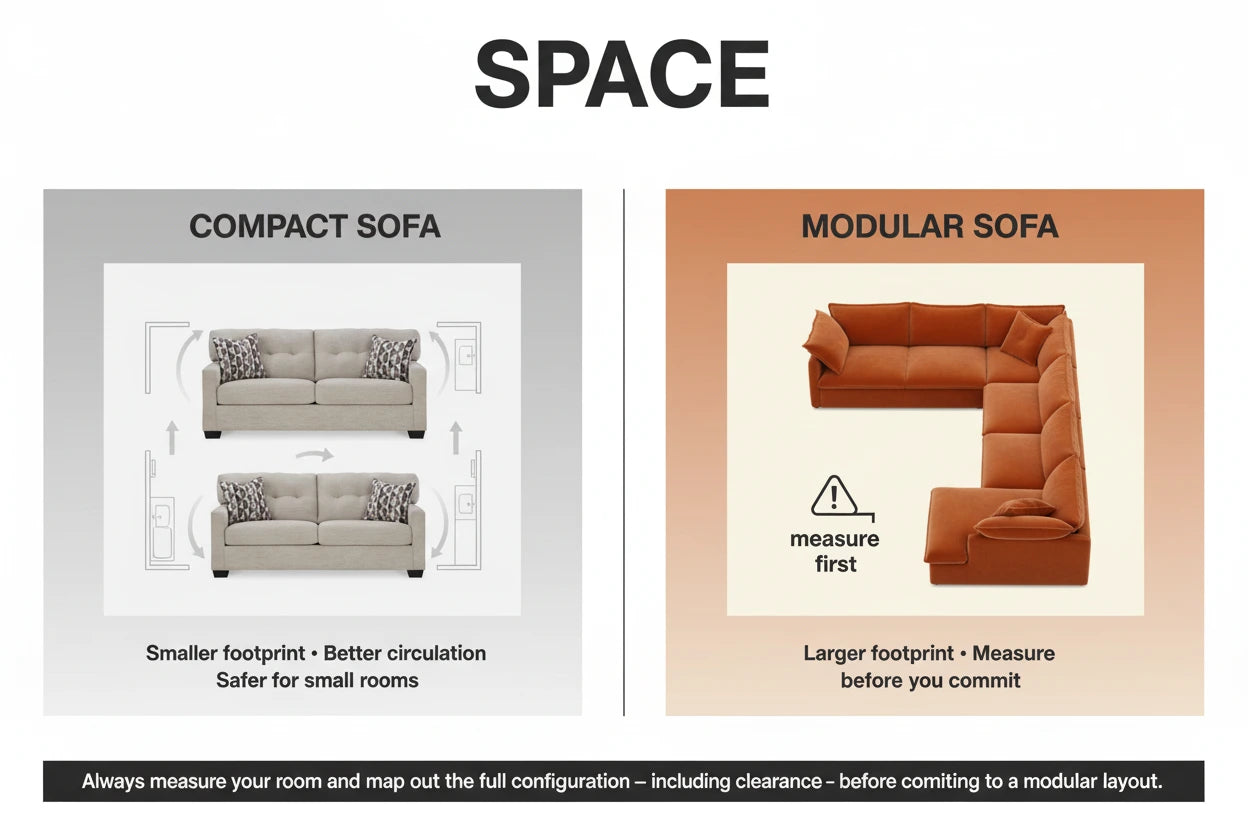
Compact sofas are the space-efficient choice. A standard 2-seat compact sofa typically measures around 55-70 in wide × 30-33 in deep, occupying roughly 13-16 sq ft of floor space. A 3-seater runs 75-85 in wide × 32-35 in deep — about 17-21 sq ft. That leaves meaningful room for circulation and other furniture in rooms under 150 sq ft.
Modular sofas work differently. A 3-module straight configuration typically covers 90-105 in × 36-38 in — around 23-28 sq ft. Once you add a chaise or corner module to form an L-shape, the footprint jumps to 110-130 in × 85-100 in, or 65-90 sq ft. A U-shaped configuration can exceed 100 sq ft.
Before committing to a modular layout, map out the full configuration on your floor using painter's tape — including 18-24 in of clearance on all walkable sides.
Layout Flexibility
A compact sofa gives you exactly one configuration: the one it came in. For rooms with a fixed layout and no plans to rearrange, that is perfectly sufficient — one less decision to make.
A modular sofa typically supports 3-5 distinct configurations from the same set of pieces: a straight row, an L-shape, a U-shape, a chaise setup, or split modules placed in separate areas. If you add one or two extra modules later, those numbers expand further. This modular design matters most when you are moving to a new home with a different floor plan, growing your household from 2 to 4 people, or simply want the option to refresh your layout without buying new furniture every few years.

Comfort
Compact sofas deliver solid, reliable comfort for everyday sitting — whether you're working from home, having a conversation, or reading.
Modular sofas are generally designed with deeper seats and more lounging surface area, making them better suited to relaxed evenings, movie nights, and situations where multiple people want to stretch out at the same time.
If comfort during extended lounging or family use is a priority, modular typically wins. If you primarily sit upright and don't need a large seating surface, compact is more than sufficient.

Cost
Compact sofas typically start at $300-$500 for entry-level fabric options, with mid-range models landing at $500-$800. The lower price reflects the simpler structure and fixed size — what you pay upfront is the full cost.
Modular sofas carry a higher entry point: most quality options start at $1,000-$1,500 for a base configuration of 3 modules, with full L-shaped or U-shaped sets typically running $1,800-$3,000+. However, the cost structure is different — you buy the base now and add modules later as needed, rather than replacing the sofa entirely when your space or household changes. For someone who moves every 2-3 years or expects to need more seating within 5 years, the cost-per-year comparison can favor modular.

Moving & Delivery
A compact sofa ships as one piece, typically weighing 80-120 lbs. To get it through your home, you need a front door at least 32 in wide (standard US doors run 32-36 in), a hallway at least 36 in wide for maneuvering, and a staircase or elevator that can handle a piece roughly 75-85 in long. Many deliveries fail at the hallway turn — measure before you order.
A modular sofa ships in 3-6 separate pieces. Each module typically measures 24-30 in wide and weighs 30-50 lbs individually, which makes them far easier to carry through doorways, up stairs, and around tight corners. The trade-off: you will need two people to move most modules safely, and a full L-shaped set still involves carrying 4-6 trips worth of pieces.
Neither type is guaranteed to be easier to move; the key is measuring carefully regardless of which style you choose.

Best for
A compact sofa is the right fit if two things are likely to stay constant: your room size and your household size. In a stable one-bedroom or small apartment where you do not expect significant changes, a compact sofa can serve you well for years, though durability depends on price, materials, and daily use. It suits renters, budget-conscious buyers, and anyone who values simplicity over flexibility.
A modular sofa makes more sense when at least one of those variables is likely to change. Moving from a 500 sq ft apartment to a 900 sq ft home? A modular sofa reconfigures rather than gets replaced. Growing from 2 people to 4? Add two modules instead of buying a new sofa. Planning to be in your current place for 2 years, then relocate? A modular sofa moves with you and adapts to whatever floor plan comes next. It suits families, frequent movers, and anyone investing in furniture that grows with them.
For a deeper look at how to use a modular sofa in tighter spaces, the guide to choosing a modular sofa for small living rooms covers the key considerations in detail.

Pros and Cons of Compact Sofas and Modular Sofas
Each type has a clear set of advantages and trade-offs, and the better choice depends entirely on your situation — not which type is objectively superior. Knowing the specific pros and cons of each will make the decision straightforward.
Pros and Cons of Compact Sofas

Pros:
- Takes up less floor space, leaving more room to move around
- Lower starting price — easier to commit to without overthinking
- Simple to style; works in most room layouts without planning
- Visually lighter, which helps smaller rooms feel more open
- Less surface area to keep clean
Cons:
- Fixed layout — what you buy is what you get
- Seats fewer people comfortably; not suited for lounging
- No way to expand if your household or room changes
- If it no longer works, you replace the whole thing
Pros and Cons of Modular Sofas

Pros:
- Rearrange it, expand it, or split it — the layout works around your life
- Ships in separate pieces that fit through tight doorways and elevators
- Add a module later when the family grows or you move somewhere bigger
- More surface area for stretching out, movie nights, and everyday family use
- Better long-term value if your space or household is likely to change
Cons:
- Higher starting price than most compact sofas
- Needs more planning to configure without wasting space
- Modules can shift on hard floors if connectors are not solid
- Larger footprint in most configurations — not suited for smaller rooms
Compact vs. Modular: Which One Fits Your Lifestyle?
The right sofa depends less on which type is objectively better and more on which one fits how you actually live. Here's a quick way to decide.
Choose a Compact Sofa If...
- You live in a studio, small apartment, or compact living room
- You're renting and may need to move relatively soon
- You have a tight budget and want a quality sofa without a large investment
- Your room layout is fixed and unlikely to change
- You prioritize visual lightness and open floor space over seating volume
- You want a low-risk purchase with a straightforward delivery and setup process
Choose a Modular Sofa If...
- You have a medium to large living room or an open-plan space
- You have or expect to have a growing household or frequent guests
- You want the freedom to rearrange your layout seasonally or after a move
- You prioritize comfort for lounging, movie nights, or multi-person use
- You're looking for a long-term furniture investment you can adapt over time
- You want the option to add more seating in the future without replacing the whole sofa
For a curated list of top-rated options, see the 9 best modular couches of 2025 to compare styles, sizes, and configurations.
Compact & Modular Sofa Recommendations
After comparing both types across space, comfort, cost, and long-term value, two options stand out — one for each use case. Both were selected based on how well they deliver on the core promise of their category.
Ashley Mahoney Compact Sofa

Best for: Small Apartments and No-Fuss Buyers
The Ashley Mahoney does one thing well: it fits where bigger sofas don't. It's a sit-up sofa — not built for sprawling out, but reliable for everyday use in a small living room or bedroom. The fabric holds up to normal daily wear, though pet owners or households with young kids may notice it shows stains more visibly over time since covers cannot be removed for washing. No complicated setup — it arrives, you place it, done.
Price: $599
Pros: Compact footprint; works in rooms other sofas won't fit; clean profile that doesn't crowd small spaces; no assembly stress; budget-friendly starting price; multiple fabric choices
Cons: Covers not removable or washable; not comfortable for lying down; no flexibility to expand or reconfigure; shows pet hair and stains more easily over time
Why we pick it:- Gets through standard apartment doors without disassembly — one less thing to deal with on moving day
- At this price, it is a low-risk first sofa for a new apartment or short-term living situation
- The simple silhouette does not make a small room feel crowded
- Straightforward enough that setup takes minutes, not an afternoon
WJS Home Cloud Orange Modular Sofa
BLOG-ONLY: Get 10% OFF
Best for: Families, Pet Owners, and Anyone Who Actually Uses Their Sofa
The WJS Home Cloud Sectional is the kind of sofa that gets used — not preserved. The covers pull off completely and go straight into your home washing machine, which means a spilled coffee or muddy paw print is a 10-minute fix, not a cleaning bill. Each module arrives separately and snaps together in about 25 minutes, so navigating an apartment elevator or tight hallway is manageable rather than a nightmare. If your family grows or you move to a bigger place, you can add a module without starting over. The cloud-soft fill holds its shape well under real daily use — including kids who treat the sofa like a trampoline.
Price: $2,230
Pros: Covers come off and machine-wash at home; cloud-soft fill that holds its shape over time; ships module by module for easier delivery; built-in storage under every seat
Cons: Higher upfront cost; needs a room of at least 200 sq ft to work well; too much sofa for a studio or compact apartment
Why we pick it:- Families with pets or young kids report the washable covers as the feature they use most — not just a selling point, but something that changes how you live with the sofa day to day
- Getting it into a standard apartment building is manageable since each piece ships and moves independently
- The built-in storage under the seats earns its keep in living rooms that double as storage-challenged spaces
- You can add a piece later instead of buying a whole new sofa when your needs change
Conclusion
If space is your priority, go compact. If flexibility is your priority, go modular.
The best sofa is the one that fits how you actually live — not how you wish you lived. A compact sofa works when your room is small and your situation is stable. A modular sofa works when your household, your room, or your plans are likely to change.
If you are leaning toward a modular sectional built for real family life — washable, cloud-soft, and designed to grow with you — browse the full collection at WJS Home.